Reflecting on Participatory Approaches

Participatory approaches to health demonstrates a positive transformation of Health education. These approaches stray from a limiting form of education, as they reframe how we approach the curriculum. This contemporary move forward in education develops students  21st century pedagogy skills that promotes active participate in their learning (Welsh & Leahy, 2018). 

Given participatory learning strategies are integral to the effectiveness of health education n programmes (Herbert and Lohrmann, 2011), it is staggering to see the scarcity of participatory pedagogies used to deliver the curriculum. As the traditional teacher dictated activities tend to remain heavily relied upon (Cahill et al., 2014). Cahill and colleges (2014) conducted a study across 75 Australian schools to find that a mere 6% of educators used a participatory approach to education almost every lesson, and 54% of educators used this approach a few times per year. Highlighting the need for more contemporary approaches in our schools. However, encouraging educators to adapt a participatory approach is only half the battle, as it must be ensured that the intervention is delivered effectively.

When implemented correctly, promoting students  to take ownership and responsibility of their learning will consequently lead to greater academic achievement. However, commonly due to a lack in understanding the framework, schools implementations are not as effective as their potential (Cahill et al., 2014). It seems that participatory approaches are often not implemented in an effective and engaging way that provokes genuine participation from the students (Carlsson & Simovska, 2012).

Educators identified that their relationships with students and their level of confidence about classroom management influenced their choice of learning activities. Hence, developing positive teacher student relationships and effective class management skills would lead to a more successful participatory program. Additionally, some teacher may find it challenging to shift from norms which favour teacher-student interactions but offer few opportunities for student–student interactions (Cahill et al., 2014). Teachers have acknowledged that training in the use of participatory pedagogies, in addition with guided teacher resources had an influence on the motivation and readiness to incorporate these strategies (Cahill et al., 2014). Therefore, school wide teacher education is required to equip the teachers with successful frameworks and cognitive skills required for successful implementations of participatory approaches.

In my own experiences, I have noticed that teachers often depend on teacher directed learning, particularly in VCE. In the latter years of school time constraints are at their highest, and understandably perhaps the most efficient option would be a didactic approach to teaching. However, with this emphasis on quantity of learning outcomes, the quality of learning is often overlooked. Looking back on my own schooling, the best learning experiences occurred when I was given the freedom to explore and the ability to collaborate with my peers. Just because the traditional approaches may be familiar, it does not mean that the teachers of today have to abide by them. Educators are given the platform to be creative and different, the opportunity to push for the evolution of health education. Educators must steer towards these contemporary approaches that encourages students and teachers to work together.
Youth Voice

Three examples of Participatory Approaches

Shape Up (Simovska,2018)- A school community approach to influencing determinants of a health balanced growing up. The approach aims to develop students capability  to critically research and act to enhance health related conditions within the school and the wider community.

Leading Education About Drugs (LEAD)-  Students plan and coordinate their education. Students develop self-efficacy in action and leadership as they experience first-hand how they can be students valuable recourses as they are active participants in decision making. An example of this was where students planned and coordinated  a fashion parade that modelled written messages to parents of the assumptions about drugs.

Seniors Students educate Junior Students- Students are encouraged to deliver parts of the curriculum to junior students as they work with their teachers collaboratively . The senior students input is valued as they construct strategies in delivering the content.

Screen Shot 2018-09-09 at 7.33.09 PM

My Constructed Participatory Activity 

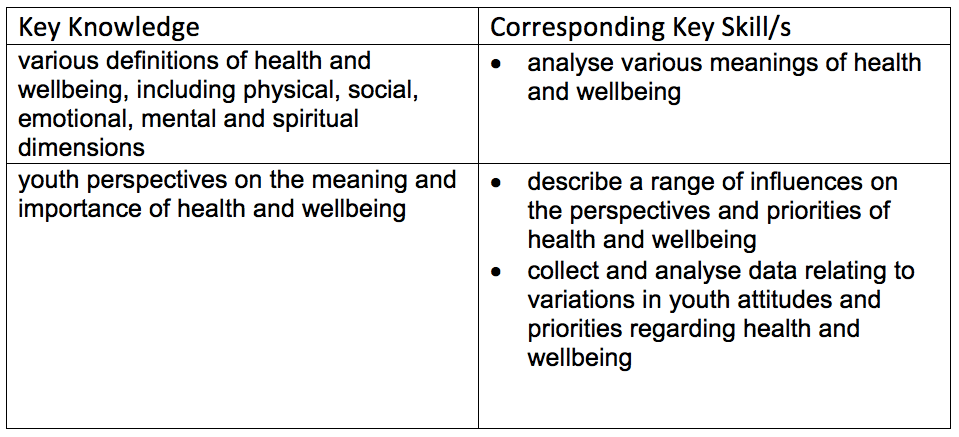
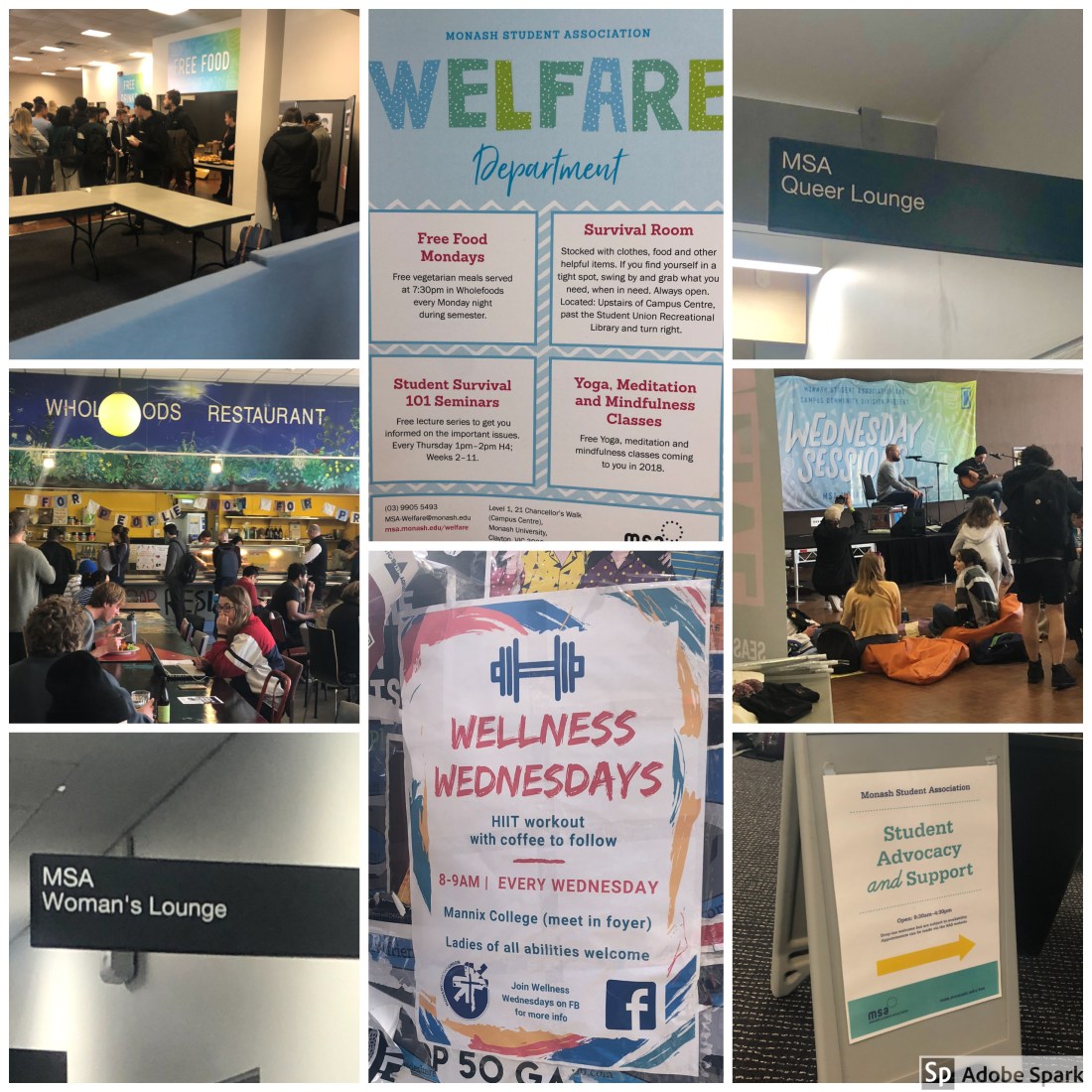
  1. In small groups collect /take images from around campus that you believe depict various definitions of health and wellbeing, including physical, social, emotional, mental and spiritual dimensions to show a youth perspective on the meaning and importance of health and wellbeing.
  2. From these photographs as a group identify the dimension of health and wellbeing that you consider is under-represented within the school community. Discuss a range of influences on the perspectives of health and well-being priorities.
  3. Develop an intervention that showcases and promotes youths perspective and priorities on the health and wellbeing from this under-represented dimensions.
  4. Present these interventions/showcases to the class to highlight the various perspectives and definitions to health and wellbeing across the groups.

My Post-2

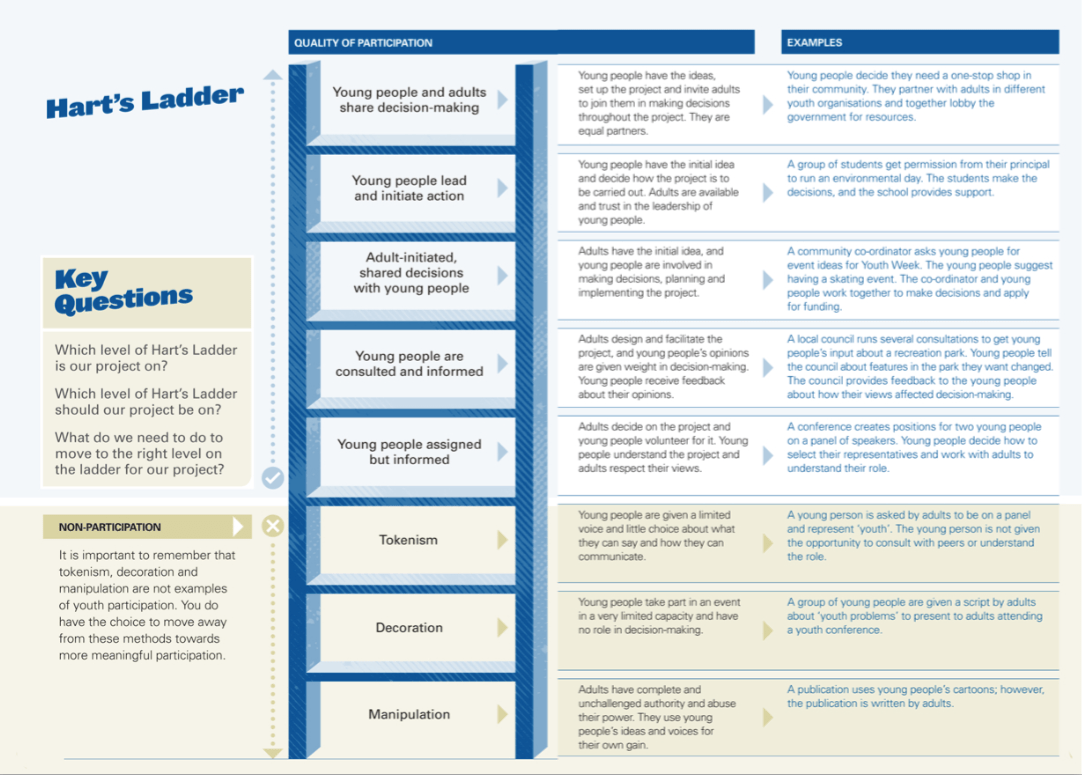
Applying Hart’s ladder to the learning activity

Screen Shot 2018-08-28 at 3.51.51 PM

This activity ideally would target the top two levels of participation; completely student driven or youth adult equity. As these demonstrate the highest quality of student participation, where the students set up the intervention on health and wellbeing based on their own initial ideas. Realistically, considering the activity must be scaffolded to the curriculum, it is therefore not completely student driven as set guidelines and limitations regulate what the students can explore. These guidelines must be in place in order for the teacher to grade their work corresponding to the curriculum. Hence, due to deadlines and strict learning objectives participatory approaches are scarce in VCE. However with the correct scaffolding an effective participatory approach can still be implemented, albeit slightly lower than the top level of participation. Harts (2008) research implies that pedagogical processes that promote  students partaking in hands-on experience in a health-promoting manner lead to progression of children’s knowledge, competence, and motivation in regards to the enhancement of one’s own health. In the activity above, genuine participation is sought-after, encouraging students to have greater responsibility in regards to the learning process (Hart, 2008). Thus keeping students engaged and motivated to acquire the knowledge and employ it in dynamic ways (Simovska, 2018).


Reference:

Simovska, V. (2012). Case study of a  Participatory Health Promotion Intervention in School. Democracy in Education, 20 (1), 1-10.

Hart, R. A. (2008). Stepping back from ‘The ladder’: Refl ections on a model of participatory work with children. In Participation and learning (pp. 19-31). Springer, dordrecht.

Digital Media and Sexuality

Research has shown that there is a lack of pre and in service training in regards to media and sexuality studies (Albury, 2013) . Many teachers tend to take a “defensive education” approach when it comes to attacking the “hot topics” such as pornography, sexting, and online relationships. As educators want to avoid drawing negative attention from parents and the vast community, and consequently choose the “safer” option and avoid controversial topics (Albury, 2013). In turn, Schools rely on pre-produced recourses as appose to engaging in the youths own media practices.  The general dismissal of media as a source for sex education can detrimentally effect students engagement as it lacks relating these “real issues” to the students’ everyday lives. The students will be exposed to these issues outside of school, and thus it seems pointless to shelter them from the appropriate and helpful information that can be provided in a school setting. As appose to having media acting as a distraction to learning, teachers should aim to adjust their approach to include students preferred content in order to increase engagement. Incorporating reparative media representations avoids an over-reliance on models of critical interpretation that largely acts to dismiss a text that could be considered as normative. Thus teachers should aim to creating an appropriate intertwining of pleasure and pedagogy (Albury, 2013). As a whole, educators should aim to avoid explaining how a text might be empowering or demeaning but rather to examine what it is that the youth do with these texts (Sedgwick & Frank, 2003). Consequently health educators should intend to keep an open mind and be responsive to different methods of learning, pedagogy and literacy. Below is a key example of how contemporary approaches towards media are intertwined with health education.

Anecdotal Media Activity
During a tutorial at Monash university we were asked to take a selfie that doesn’t show your face that your friends might recognize you by (Captured Below). I chose to take a picture of my socks as “fun socks” is a quirk of mine that my friends are aware of.

IMG_7722

This demonstrates to the students how anyone can create messages in the media, and explores how an audience may decode these messages. The point could be highlighted that the students close friends would view this text (their selfie) completely different to how a stranger would. Linking how students “develop a capacity to respond to health information, advertising and other media messages, enabling them to put strategies into action to promote health and wellbeing in both personal and community contexts” (VCAA, 2018). Additionally the activity could be scaffolded to address the challenges and opportunities presented by digital media and health technologies, linking to VCAA unit 2: Managing Health and development (2018). Finally, developing ones media literacy is an integral part of health studies, as the two disciples tend to intertwine within the world and would explain why media analysis is a common form of assessment for VCE health and human development.

The broadening of Australian law in 2005 now acts as a Barrier towards this contemporary health approach, where we consider students becoming media and health literate through participation. Considering the Australian law defining child pornography as potentially any sexually suggestive depiction of a person who appears younger than 18 years (Albury, 2013), it is very understandable that educators want to remain in the “pre-classified” realm of recourses. As it can be very easy to introduce students to a space where they may incriminate themselves or others. Additionally, educators need to understand how the young people use media, to create useful resources. However, given the infinitude of media access for the youth, it is practically impossible to identify the source of certain beliefs and practices (Albury, 2013). So the question still remains, how we can comprehend how a text can influence beliefs and attitudes in consideration of sexual health and relationships?


Reference:

Albury, K. (2013).  Young people, media and sexual learning: rethinking representation, Sex Education, 13:sup1, S32-S44, DOI: 10.1080/14681811.2013.767194

Sedgwick, E. K., & Frank, A. (2003). Touching feeling: Affect, pedagogy, performativity. Duke University Press.

Victorian Curriculum and Assessment Authority. (2018). VCE Health and Human Development Study Design. Retrieved from Victorian Curriculum and Assessment Authority: https://www.vcaa.vic.edu.au/Documents/vce/hhd/HealthHumDevSD-2018.pdf


Design Thinking and Digital Health

Digital technologies is a profound contributor towards modern day healthcare and preventive medicine. A vast array of devices and software is now used across biomedical and health domains, with approximately 260,000 health and medical apps demonstrating the staggering level of accessibility (Lupton, 2017). Contemporary digital health has now positioned lay people as both active and passive consumers of health and medical information, thus intertwining lay and professional knowledge and expertise (Lupton, 2017). Patient self-care technologies, search engines, health care websites, Telemedicine and social media are some major examples of digital health which has paved the way towards contemporary health care.

A major critical aspect of digital health is removal of the traditional face-to-face care. When the physical aspect has been taken out of consultations, forms of “invisible labour” are required on behalf of the health care professionals. Additionally, the physical-examination by a doctor often inspires trust in the patient whilst portraying empathy and care (Lupton, 2017). Without this patients must seek other ways to determine the level of trust for their doctor. Furthermore patients may be required to perform their own physical-examinations, which raises concerns on the validity of the data. Patient self-care technologies have drastically assisted the “do-it-yourself” process fostering  the ideology of empowered patients, however the fallibilities and limitations of these technologies are often not acknowledged by the provider (Lupton, 2017). Contemporary digital health now implicates that health professionals must ask different forms of questions that compensates for the lack of the personal interactions and deciphers the digital information provided.

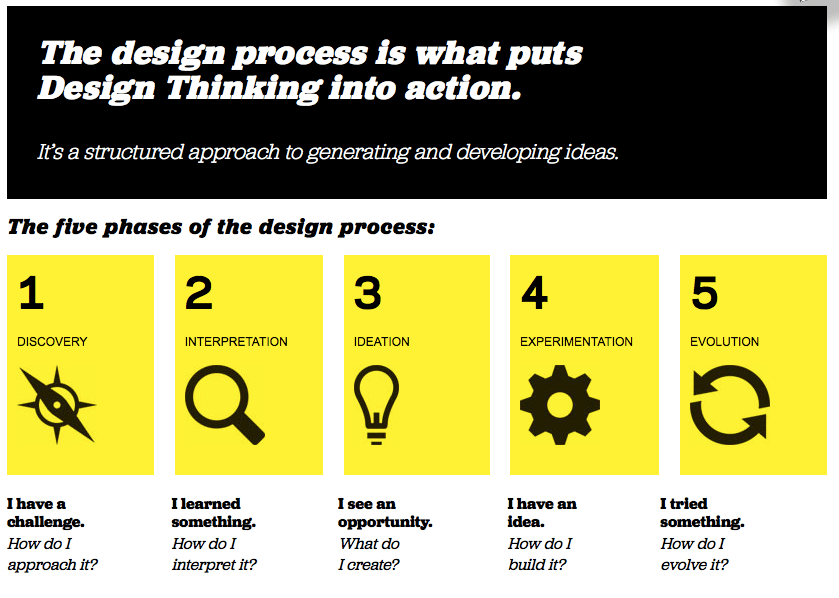
Screen Shot 2018-08-27 at 11.53.33 AM.png

Design Based Thinking (DBT) is a creative process that helps design meaningful solutions in the classroom, the school and the community. The five phases of digital thinking (as above) demonstrates a pedagogical process that  can be effectively utilised within digital health.


My Anecdotal experience with DBT

We were asked to randomly chose on element from the 4 categories; a body part/system, a demographic, a location, and a feeling. Our group selected had selected Blood, Children, the home and reassured. Then Using guided questions we were to collaboratively think of a related health problem and brainstorm a digital invention that would provide aid and could be used within the context we had randomly created. Then using the storyboard activity (pictured below) we envisioned a real world scenario where our invention could be practically used.


Reflecting on Bloom’s taxonomy and 21st century pedagogies in relation to DBT

Using these frameworks a talented teacher can scaffold the DBT activities to tailor the level of learning to the individual. Additionally an effective activity can incorporate all discipline areas for the 21stcentury learner. “In today’s world, it’s no longer how much you know that matters; it’s what you can do with what you know” (Wagner & Danchin, 2010, p. 111). Thus DBT is an effective way to encourage students to “use” their health knowledge to “create” change within the community.  The above example shows that when DBT is done with a collaborative approach it reach all disciplines that umbellar under the engaged thinker, ethical citizen and entrepreneurial spirit.


Reference:

Lupton, D. (2017, April 16). Design Sociology part 1: a research agenda [Web blog post].  Retrieved from https://simplysociology.wordpress.com/2017/04/16/design-sociology-a-research-agenda/

Lupton, D. (2017, April 21). Design Sociology part 2: terms and approaches [Web blog post].  Retrieved from https://simplysociology.wordpress.com/2017/04/21/design-sociology-part-2-terms-and-approaches/

Wagner, R. H., & Danchin, É. (2010). A taxonomy of biological information. Oikos, 119(2), 203-209.

IVAC model in Contemporary Health Education


My Post.jpgThe Victorian curriculum now emphasises that food and nutrition is not solely about the nutritional values and guidelines, but additionally on food literacy and studies on a diverse scale (Welch & Leahy, 2018). The old deficit education model placed responsibility of one’s food consumption exclusively on the individual (Welch & Leahy, 2018). Today, it is vital to highlight that ones’ everyday diet is related to multifaceted factors related to cultural practices, social inequalities and socio-political factors, regardless of how familiar students are with nutritional guidelines (Welch & Leahy, 2018). To the left is a meme that demonstrates how a families culture can directly influence on an individuals diet. Guiding principles have been implemented to encourage a contemporary approach towards food and nutrition. These guidelines ensure that pedagogies are delivered with a strength based approach in developing health literacies with the inclusion of critical inquiry tasks. Additionally, highlighting the fact that nutrition is merely an element within a broader food study. The guidelines outline that educators must make links to agriculture and cooking experiments in conjunction with community based connections to culture, history and online media. Teachers must question who makes and sells the educational recourses to ensure their credibility, and finally, educators must consciously act to minimise body shaming and links between weight and food (Welch & Leahy, 2018). These guidelines are an attempt to progress towards a contemporary approach to health education.

Participatory approaches to food has become a contemporary strategy in food and nutrition education. A systematic review on the effectiveness of school health promotion declares that programs that consider contextual factors and highlight multifaceted approaches increase the likelihood of effective health outcomes (Stewart-Brown, as cited in Carlsson & Simovska, 2012). Furthermore,  the Investigation-Vision-Action-Change (IVAC) approach, school-community collaboration, pupil’s participation and action-orientated teaching are pivotal factors in the level of learning outcomes achieved (Carlsson & Simovska, 2012). When incorporating a participatory approach in one’s teaching it is important to address these vital elements in order to develop the “students ability to act, initiate and bring about positive change with regard to health” (Carlsson & Simovska, 2012). The IVAC model is an effective strategy in encouraging a participatory approach whilst incorporating the propositions implemented by HPE Vic curriculum.

How the IVAC model connects to the propositions

Investigate– relates directly to developing a student’s health literacy. Where students are encouraged to selectively access and critically analyse health information from a range of sources in attempt to take action to improve health and wellbeing of oneself or others.

Vision– developing a vision for change majorly relates to critical inquiry, as this is
a way of “approaching knowledge- inquiringly rather than acceptance of fact” (Wright, 2018). As, students can identify a health issue and challenge ways to eliminate/improve the problem through inquiry skills.

Action & Change– links to the strengthsbasedapproach as students are guided to use their skills to make healthy, safe and active decisions to enhance their own and others’ health and wellbeing. Actions experiences leaves students with a string feeling of making a difference which beautifully mirrors an effect strengths based approach.


Reference

Carlsson, M., & Simovska, V. (2012). Exploring learning outcomes of school-based health promotion – a multiple case study. Health Education Research, 437-447.

Welch, R., & Leahy, D. (2018). Beyond the pyramid or plate: Contemporary approaches to Food and Nutrition education. Active And Healthy Journal.

Wright, J. (2018). The role of the five propositions in the Australian Curriculum: Health and Physical Education. Active+Healthy Magazine, 21(4), 5-10.